


If we are uncritical we shall always find what we want: we shall look for, and find, confirmations, and we shall look away from, and not see, whatever might be dangerous to our pet theories. – Karl Popper
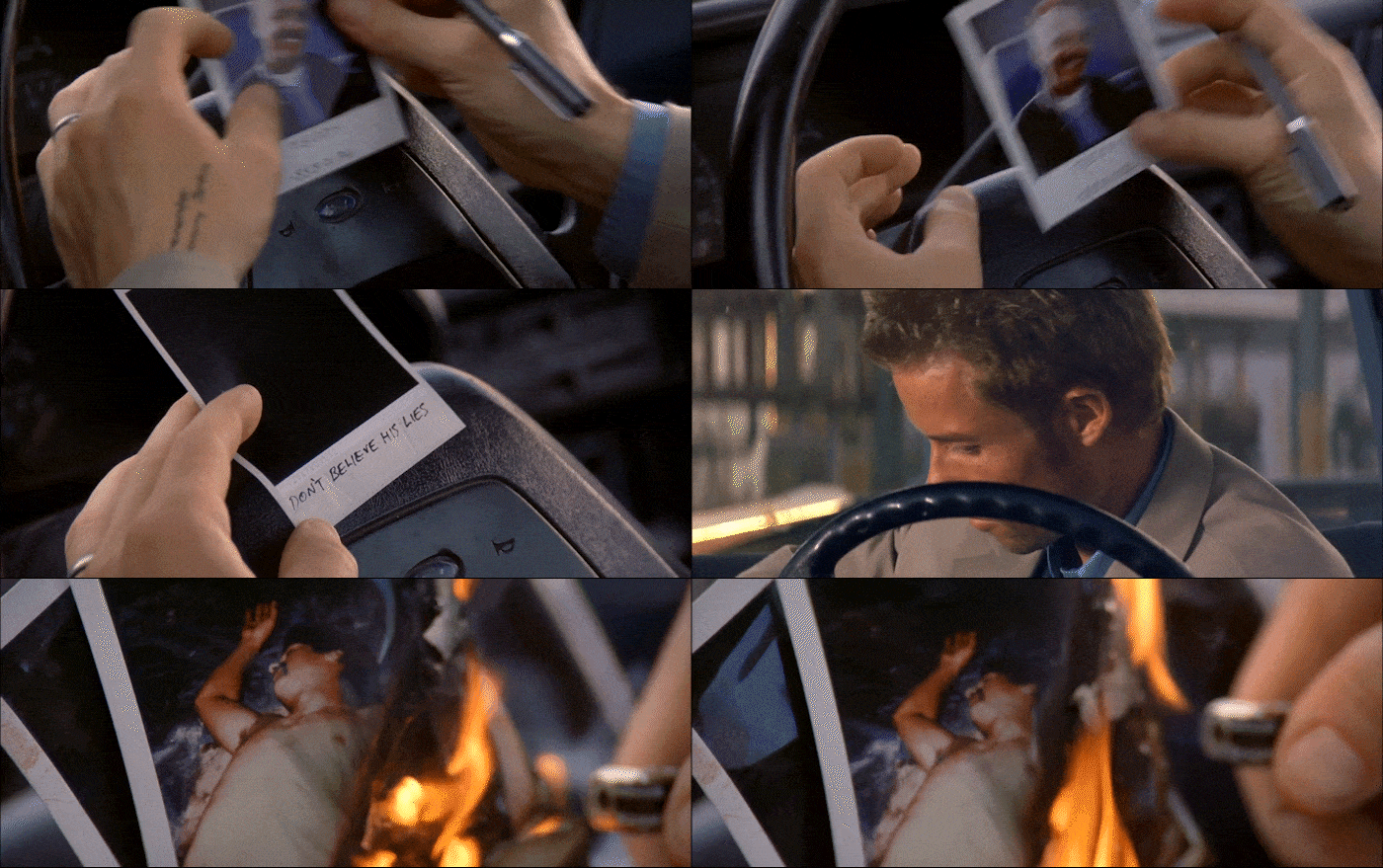
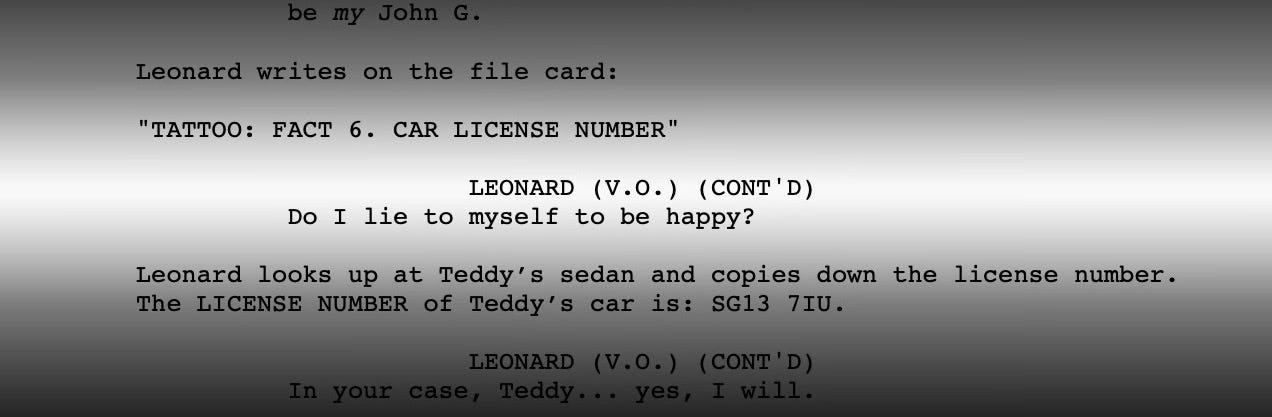
Comparing my MAGA-ed mother to Memento killer Leonard Shelby isn’t something I’m proud of, but there’s an unmistakable thread of dishonesty that connects them: when reality clashes with their worldview, it’s reality that gets edited to conform.
Leonard has a manufactured narrative that keeps him afloat: someone bonked him on the head, killed his wife, and now bloody revenge is his animating force. It grants him a semblance of coherence that his fragmented existence can’t accommodate. So when an unexpected fact gets in the way (he’s already avenged his wife’s attacker), he literally sets that inconvenient truth on fire.
After a year of no contact I decided to reach out to Mom, fingers crossed, to see if MAGA had lost any of its grip on her mind. A few minutes into our FaceTime, she tried to justify Trump and his ICE troopers by saying somebody has to do something about the gangs overrunning our country. Trump is boisterous, she’ll give me that, but at least he’s trying to stop all those child-trafficking rings.
Earlier, before our no contact days, before she helped Trump get reelected, her argument wasn’t much different: rape-y Mexicans are coming over the border in droves, shredding the fabric of America, and bringing their awful drugs and freeloading families with them. I was the delusional one for disputing these plain-to-see facts.
And it’s true, if I had been seeing the same stories my mom has been mainlining for years, absent a shred of scrutiny or skepticism, we probably would be on the same MAGA page. She’s fed a constant stream of boogeyman anecdotes on Facebook. Every Sunday she treats herself to a sermon by Heritage Foundation-aligned white nationalists, who remind her that Trump is God’s chosen vessel, mysterious though it may be. And – as long as the power is on and the cable works – the living room, dining room, bedrooms, kitchen, and breakfast nook will have Fox News in the air.
Below is one kind of distortion she sees all the time: Fox on the left, presenting “new” footage; the original on the right, from five years earlier.

There’s a lot of propaganda and fuckery aimed at Mom and those like her, to advance this immigrants-as-criminals story. But she still deserves a co-author credit for manufacturing her narrative, not unlike Leonard. One of the primary mechanisms keeping my mom MAGA is self-generated. It’s called confirmation bias. Essentially, we really like our priors and we do our best to keep them sticky. Those things that confirm our theories stand out as the shiniest of objects, and we latch onto them, keeping our priors right where they started, thank you very much. Those things that dis-confirm our story, if we’re unlucky enough to encounter them, are brushed aside, “debunked” with critiques unburdened by logic, or just flat-out treated as nonexistent.
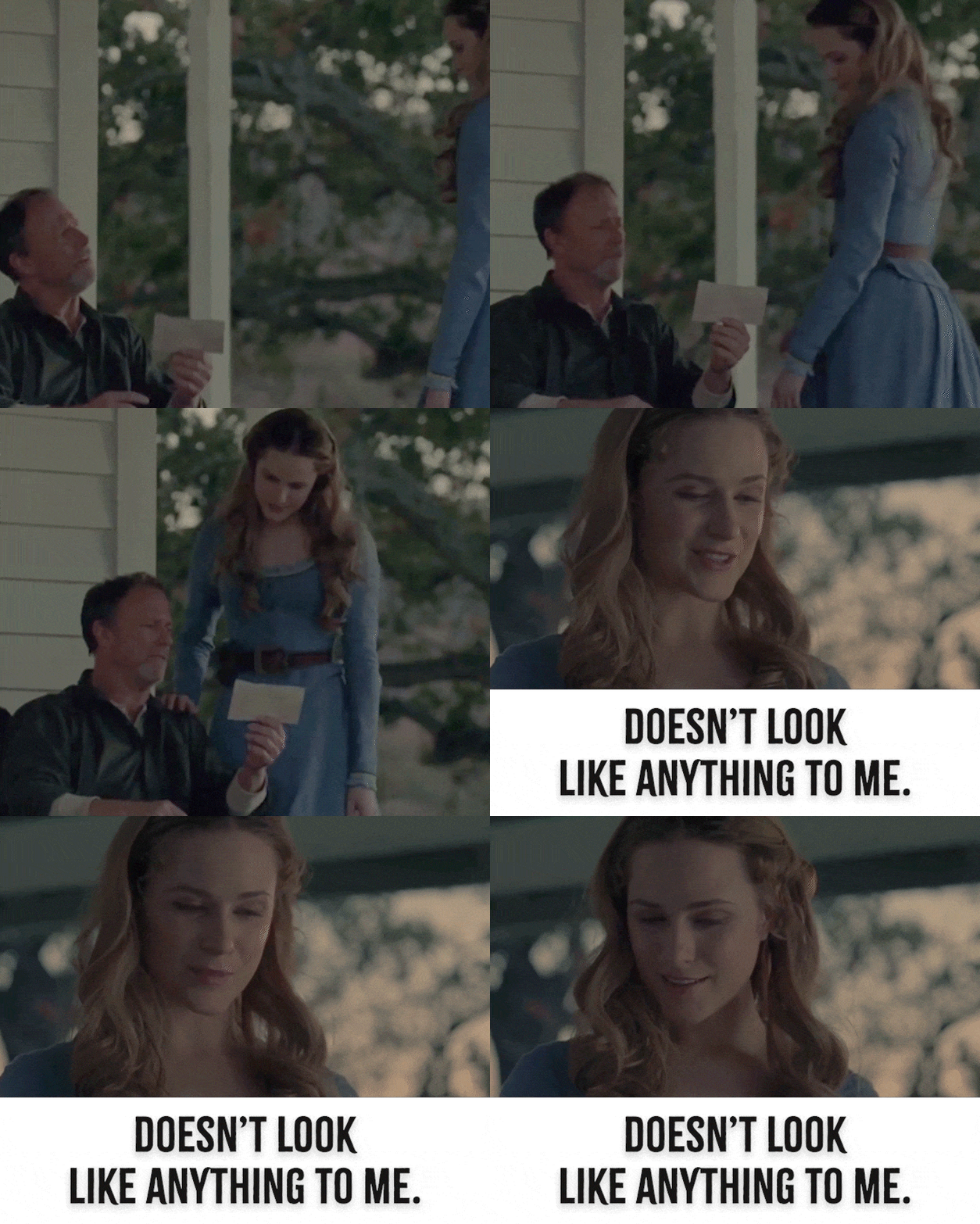
As we’ll see, we’re remarkably good at tolerating pure bullshit if it tells us we’ve been right all along. Of course actual truths can feed confirmation bias too, which keeps the waters particularly muddy. For example, this guy didn’t help:
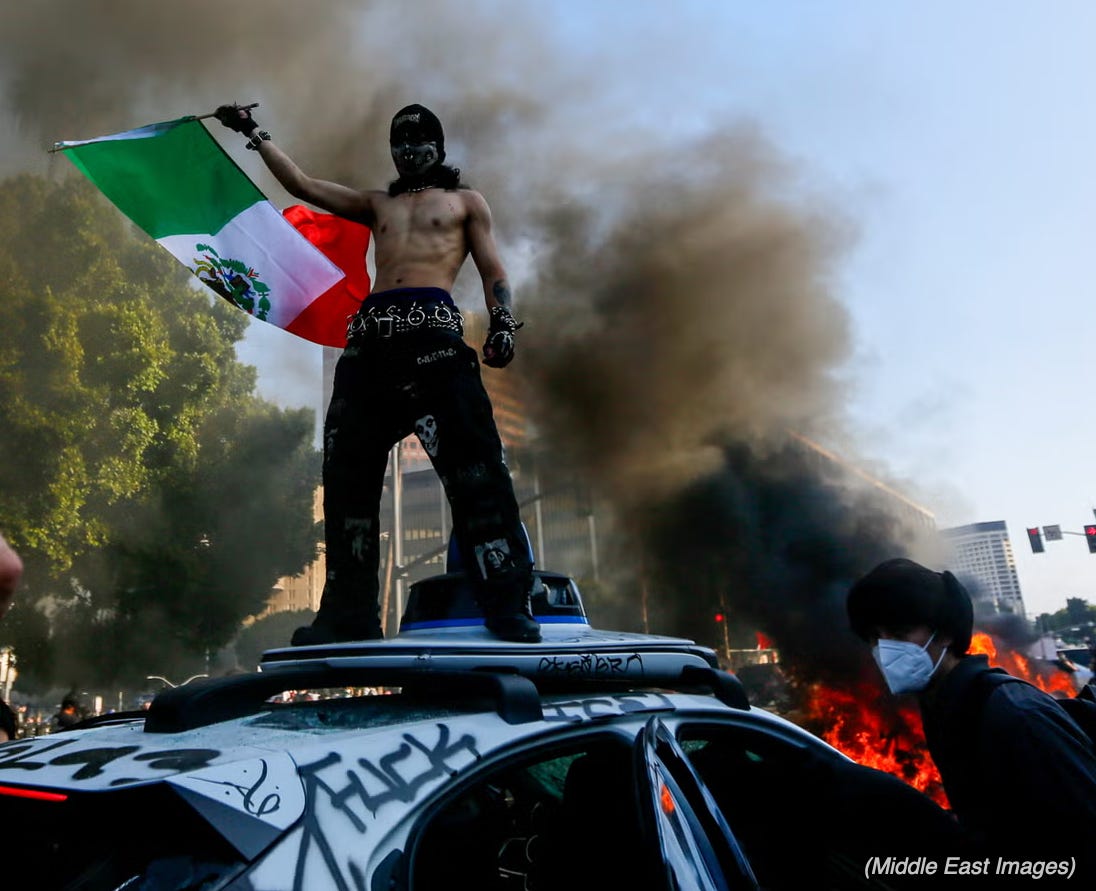
Of course the Mad Max-ian gentleman above in no way proves that immigrants are burning down the country… but I can guarantee this scene plays on an infinite loop in the nationalist MAGA mind when they imagine what’s going on out there.
Confirmation Bias /// Nothing New
Confirmation bias is a fundamental quirk of the human mind, written about since at least the ancient Greeks. In History of the Peloponnesian War, Thucydides described the tendency like this:
It is a habit of mankind to entrust to careless hope what they long for, and to use sovereign reason to thrust aside what they do not desire.1 (c. 460–400 BCE)
Nietzsche gets straight to the point, no fat to trim:
Convictions are more dangerous enemies of truth than lies.2 (1878)
Sir Arthur Conan Doyle’s Sherlock Holmes was smugly aware of this fallacy of the common dunce:
It is a capital mistake to theorize before one has data. Insensibly one begins to twist facts to suit theories, instead of theories to suit facts.3 (1891)
And then there’s the contemporary specimen of Rudy Giuliani, a kind of anti-Holmes, adopting the policy of a true fucking moron:

Confirmation Bias /// The Seminal Study
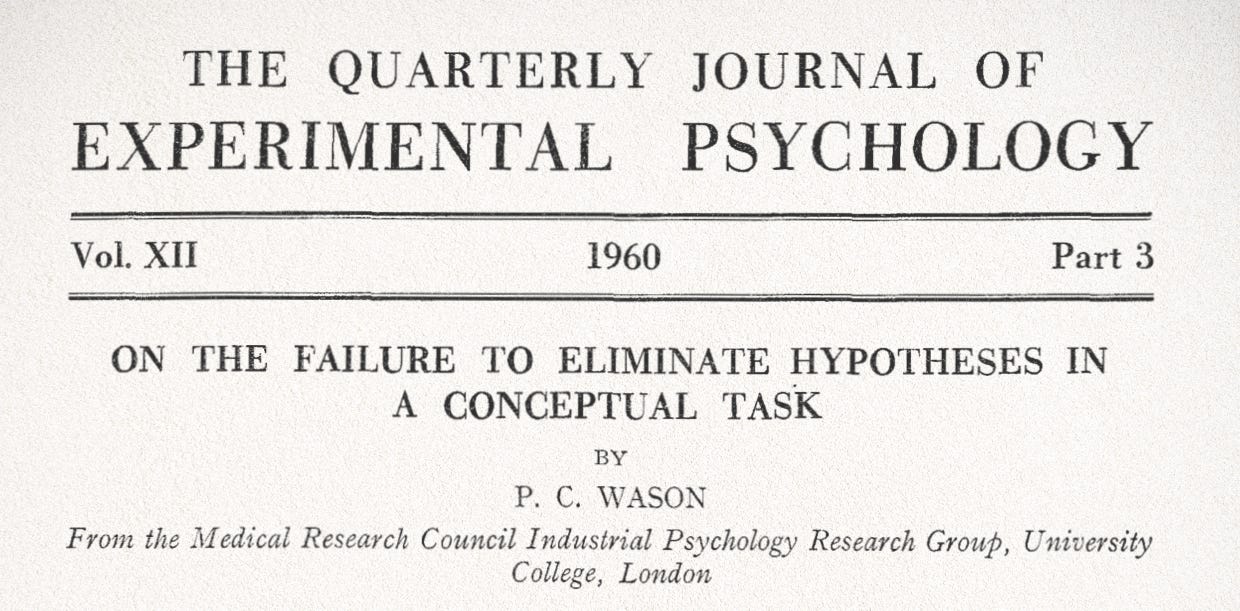
In 1960 P.C. Wason, a professor at University College, London, published a paper that challenged some of the dominant intellectual currents of the day. Game theory, introduced in the 1940s by John von Neumann and Oskar Morgenstern4, had a solid academic foothold by then. Perfect rationality was assumed, with human preferences neatly mapped onto utility functions. Homo economicus had been refined to mathematical precision.
In psychology, Inhelder and Piaget’s The Growth of Logical Thinking5 (1958) described fully developed humans as formal operational thinkers, excelling at systematic experimentation. And the English edition of Karl Popper's Logic of Scientific Discovery6 (1959) prescribed falsification (i.e. testing hypotheses by seeking disconfirming evidence) as the hallmark of scientific thinking. Wason, on the other hand, demonstrated that we were actually pretty terrible at all of this rationality stuff.7
If you want to try Wason’s famous experiment yourself, click the button below. It links out to a GitHub page with an interactive version of the 2-4-6 task. If not, just read on for the explanation.
In Wason’s experiment, subjects were given the following instructions (paraphrased):
The triplet of numbers [2,4,6] follows a rule that I have in mind. Your goal is to find my rule using trial and error. Propose a triplet and I’ll tell you if it follows the rule or not. Carry on testing until you’re pretty certain you have the rule figured out, then make your guess.
Only about one in five subjects got it right on their first guess, though they could submit as many rule-checks as they wanted before guessing. Most people locked onto their first theory and proposed triplets that backed up that hunch. For example, one popular candidate for the rule is “sequential even numbers.” So submissions might accordingly be [8,10,12], [48,50,52], or [1002,1004,1006]. Each of those earns a “Yes, fits the rule.” In general, after hoarding enough Yeses, once they felt their theory was sufficiently verified, subjects guessed the rule. But that’s entirely the wrong way to go about it.
Wason’s hidden rule governing [2,4,6] was simple and sneaky: “any three ascending numbers.” So [1,100,391] and [0,4,5] were fine, but [1,3,2] was not. The best way to make progress in this task was to try to disprove your prevailing theory by getting a No (e.g. [6,4,2]), or at least an out-of-place Yes (e.g. [8,10,14]). Getting a Yes that you already expect just leaves you where you started. In some sense, a single No is much more informative than dozens of Yeses. Final verdict: humans were biased toward confirming their theory, nowhere close to rationally optimal agents. Hence, confirmation bias.8
Confirmation Bias 2.0 /// Realistic Scenarios
So we would rather look for evidence that flatters our current theory than put our ego on the line for a little more truth. Being wrong while you’re still working things out just does not feel good… even if it’s leading you to the right destination. And that’s just when people are solving a reward-less math riddle, their only audience a (likely bored, possibly hungover) TA in Psych Lab… the stakes couldn’t be lower.
Now imagine what happens when the context is a little more realistic and ideological temperatures run a bit higher. In 1979, Stanford researchers Charles Lord, Lee Ross, and Mark Lepper investigated exactly that, in their landmark paper Biased Assimilation and Attitude Polarization.9
First, the researchers recruited subjects who were either pro- or anti-death penalty, having identified crime deterrence (its effectiveness or ineffectiveness) as a primary rationale for their stance.
Participants were asked to review several experimental findings. Some of the findings concluded that the death penalty was an effective crime deterrent. Others concluded it was not. Here’s an example of an anti-death penalty “study” used in the experiment (they were all secretly fictional, of course):
Palmer and Crandall (1977) compared murder rates in 10 pairs of neighboring states with different capital punishment laws. In 8 of the 10 pairs, murder rates were higher in the state with capital punishment. This research opposes the deterrent effect of the death penalty.
Subjects were given additional information about the methods and procedures used in each of the studies, then asked about their updated feelings, and why or why not they agreed or disagreed with the findings of each. As you might have already guessed, subjects judged studies that aligned with their original beliefs as more credible, and they discounted those that didn’t.
So, how did they justify themselves? Across the board subjects took sympathetic studies at face value, using fairly vague and benign language to describe them:
“The experiment was well thought out.” Or, “[The researchers] were careful in interpreting their results.”
But they inevitably found problems with dis-confirming research:
“The evidence given is relatively meaningless without data about how the overall crime rate went up in those years.” Or, “The murder rates should be expressed as percentages, not as straight figures.”
The punchline was that the studies were carefully and completely counterbalanced, “offering equivalent levels of support and disconfirmation,” according to the authors. In other words, subjects were given functionally identical sets of evidence – and yet each group wound up more entrenched in their original position than when they started.
It was clear that the pro- and anti- camps were not learning in any meaningful way from the evidence. Rather, they were co-opting what they needed to make their priors feel correct, and they had two different assimilation tactics. A friendly study was treated as self-evident, possibly triggering an “I fucking knew it!” under one’s breath. But when a study threatened their position, subjects became armchair statisticians – scrutinizing sample sizes, criticizing methodology, ferreting out confounding variables, and so on. The authors concluded that subjects made their hypotheses effectively “unfalsifiable” through this sort of selective skepticism. They labeled this specific form of confirmation bias biased assimilation.10
To recap, according to the Wason study: we don’t even look for evidence that undermines our theory. Per the Lord et al. study: when forced to confront contradictory evidence, we always find something wrong with it.
So, we’ve seen what confirmation bias looks like in both sterile and ideological settings. But why would we evolve a brain that actively rejects the truth? That’s in Part 2.
Series Table of Contents:
✓ Part 1: Inconvenient Truths and the Mechanics of Being Sure (My MAGA-ed Mom and a history of confirmation bias) ← [YOU ARE HERE]
○ Part 2: Tribal Loyalty and Con(fidence) Artistry (The naive view of information and two ways confirmation bias secures your seat at the table)
○ Part 3: Self-Deception and the Argumentative Mind (The deep delusion and our instinct to persuade)
○ Part 4: Unfalsifiable Bullshit and Moral Obligations (MAGA’s invincibility cheat code and the danger of thoughtlessness)
Thucydides, The History of the Peloponnesian War (c. 431–400 BCE), Book 4, Chapter 108. Translated by Richard Crawley.
Friedrich Nietzsche, Human, All Too Human (1878), Section 483. Translated by R.J. Hollingdale. Cambridge University Press, 1986.
Arthur Conan Doyle, "A Scandal in Bohemia," The Strand Magazine 2 (1891): 61–75.
John von Neumann and Oskar Morgenstern, Theory of Games and Economic Behavior. Princeton University Press, 1944.
Bärbel Inhelder and Jean Piaget, The Growth of Logical Thinking from Childhood to Adolescence: An Essay on the Construction of Formal Operational Structures. Basic Books, 1958.
Karl Popper, The Logic of Scientific Discovery. Hutchinson, 1959. (Originally published 1934 as Logik der Forschung.)
P.C. Wason, "On the Failure to Eliminate Hypotheses in a Conceptual Task," Quarterly Journal of Experimental Psychology 12, no. 3 (1960): 129–140.
The term “confirmation bias” was neither coined by Wason nor used at all in his landmark study. The term only gained traction starting in the late 1970s, with one of the earliest uses appearing in: Mark Mynatt, Michael Doherty, and Ryan Tweney, "Confirmation Bias in a Simulated Research Environment," Quarterly Journal of Experimental Psychology 29, no. 1 (1977): 85–95.
Charles Lord, Lee Ross, and Mark Lepper, "Biased Assimilation and Attitude Polarization: The Effects of Prior Theories on Subsequently Considered Evidence," Journal of Personality and Social Psychology 37, no. 11 (1979): 2098–2109.
Calling biased assimilation a type of confirmation bias is relatively uncontroversial, but the taxonomy of these terms is grounds for lively debate amongst researchers. There’s myside bias, selective recall, motivated reasoning, belief perseverance, identity protective cognition, and so on. The exact definition of each depends on who you ask.
Opening epigraph: Karl Popper, The Poverty of Historicism. Routledge & Kegan Paul, 1957, Chapter 29.