


In Part 1 we looked at what confirmation bias is and how it works. The takeaway was that we love confirming what we already think, even if evidence says otherwise. Now we turn to the evolutionary logic behind the bias.
Why do we do this?
If it’s settled that humans do this, the next natural question is why. Wouldn’t an ideal society have people predisposed to zeroing in on the truth? Wouldn’t confirmation bias leave us vulnerable to grifters who could exploit us over and over, sometimes dragging us towards things like tyranny or genocide? Well, we don’t live in a truth-maximizing society, and all that bad shit happens, kind of a lot. This optimistic view assumes that truth, noble and fit, is destined to rise to the surface in a kind of Darwinian karma. Historian Yuval Noah Harari refers to this as the naïve view of information.1 And such a view is, well, naïve.
Consider the Bible as Exhibit A. It’s arguably one of the most influential texts of all time, and it’s absolutely, unambiguously chock-full of bullshit. One of the biblical claims Harari singles out is that all humans are descended from a single Middle Eastern family that repopulated the Earth after a great flood (Genesis 9:19), a story many literalists date to a few thousand years ago.2 This is easily falsifiable by modern genetics; but it’s alive and well, right there in the Bible, treated as sacred gospel by millions. If the naïve view were correct, these narratives would have gone extinct long ago.
But back to the point. Accounts of why tend to be squishy - it’s easier to demonstrate that something happened than to demonstrate meaningfully why it happened. Why can be true on multiple levels at once. Why did you scroll down your screen a moment ago? Maybe because the language this article is written in reads top-to-bottom, and you wanted to keep reading? Or maybe because your motor cortex kicked off a neural signal, sending it all the way down to your hand, which did the scrolling? Both are correct, neither more than the other.3
With that in mind, I’ve picked four why explanations I find most intriguing.4 This installment covers the first two.
Confirmation bias as a badge of tribal loyalty
In his 2022 paper A Tribal Mind5, Eric Funkhouser borrows from signalling theory, a framework most often seen in the realm of evolutionary biology. Belief systems, he says, aren’t the soberly scrutinized, carefully curated buckets of truth we like to imagine. Instead, they’re the building blocks for our “impression management” signals - essentially advertisements of tribal membership. These signals serve as the identification badges we’re eager to display to our family at Thanksgiving, to our online followers, or to our church softball team. We know the kind of signals our tribe respects and likes to broadcast, so we shape our beliefs to fit. The signal comes first, the belief follows. And if confirmation bias helps get us across the finish line, so be it. According to Funkhouser,
Beliefs function so as to be detected by others and manipulate their behavior, primarily for the benefits that accrue from favorable tribal self-presentation.
Confirmation bias is the evidence-processing routine that keeps that public badge shiny and presentable. Consider the following hypothetical: To stay in good MAGA graces, you might one day find it strategic to endorse masked, trigger-happy goons as the only reasonable response to a terrified Guatemalan child that doesn’t have their paperwork in order. And it might require wading deep into some mean-spirited bullshit to justify that endorsement. So if you have to perform some confirmation bias gymnastics, by all means, go right ahead; the louder and more sanctimonious the better. Why update your priors when they already prove you’re a branded member of the winning team?
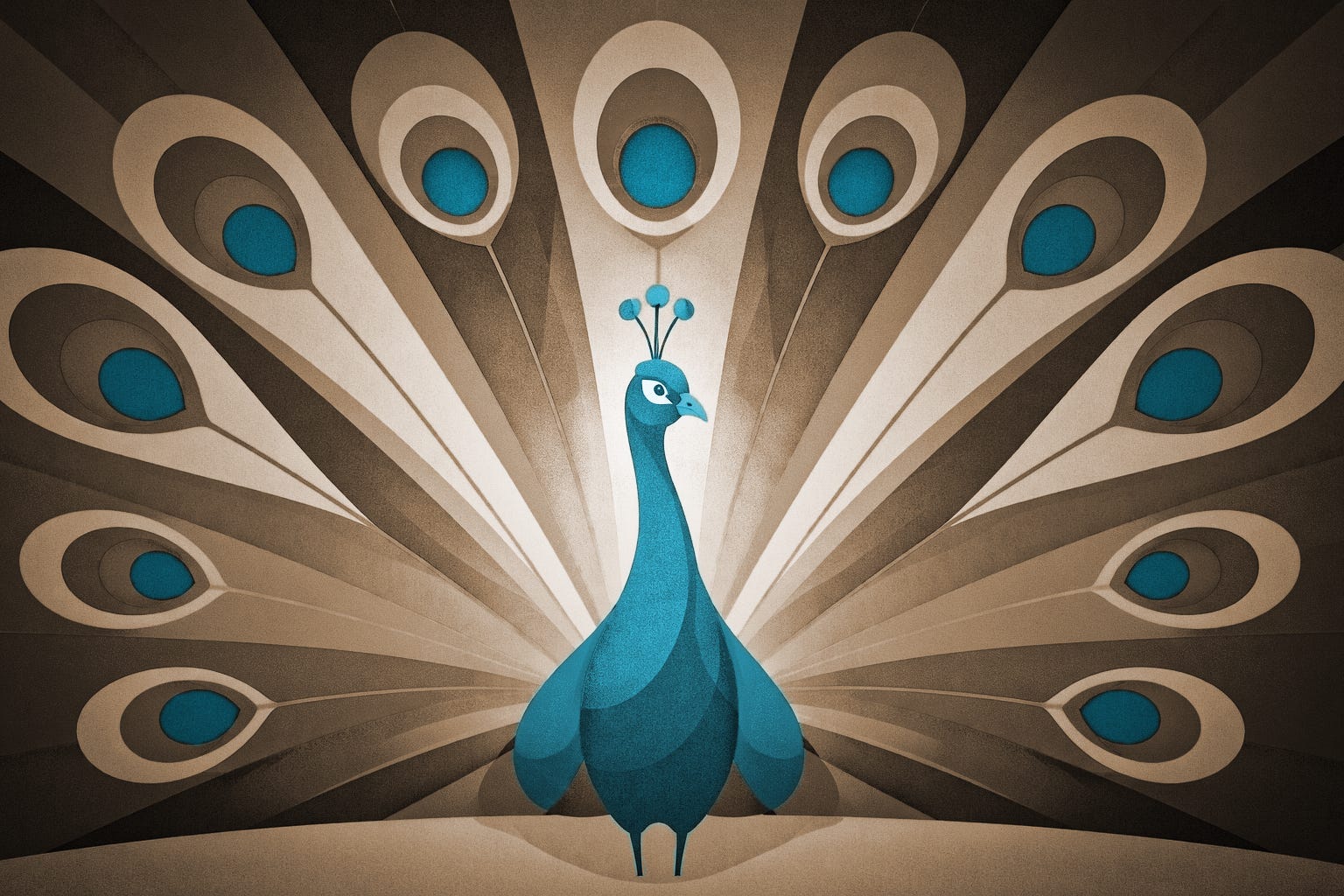
In a follow-up paper (the aptly-titled Dangerous Beliefs, Effective Signals6), Funkhouser digs deeper into signalling theory, adding its handicap principle to our tribal signalling playbook. Most often explained in high school biology or David Attenborough documentaries by invoking a peacock’s tail, the handicap principle says that that fabulous tail makes Mr. Peacock sexier precisely because he’s willing to stand out to prey like a clumsy bullseye in the name of romance.7
In human signalling games, costly signals can be more credible because the cost itself proves commitment. The payoff is social currency: status, belonging, or dominance. If the signal delivers those, the risk is worth it. As Funkhouser explains,
Danger efficiently communicates social identities and, most significantly, has value as a handicap in a signaling game.
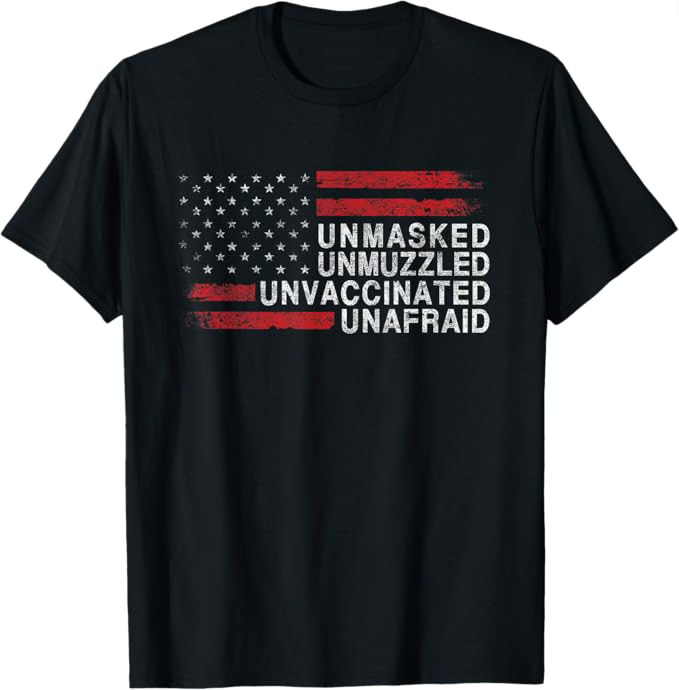
Burning bridges with the out-group is a common dangerous signal. Being aggressively MAGA might just seem reckless to the uninitiated, making one look like a shitty, racist asshole to polite society… but that’s the point. In the paper Funkhouser relates seeing a person during the height of COVID, wearing a shirt reading “Unmasked. Unmuzzled. Unvaccinated. Unafraid.” Now that’s one brave badge of loyalty – its proud, fashion-forward owner reveling in danger like a pig in shit. “It is good to trigger the ‘libtards,’” Funkhouser writes, “and this belief signals partisanship. The shirt also conveys a more personal message – that they are the type of person who is strong and courageous.”
Confirmation bias to preserve unwavering confidence
In terms of sexy tribal signals, right next door to loyalty lives confidence. Evidence suggests that confidence alone pays: Judges and juries are more likely to believe and excuse inaccuracies of witnesses who appear very confident.8 Confident people dominate group decisions, regardless of competence.9 And we trust the wisdom of confident advisors, even when they’re wrong.10
“All you need in this life is ignorance and confidence, and then success is sure.” — Mark Twain (Letter to Mrs. Foote, 1887)
So, what happens if you overplay that confidence hand, and just bullshit how great you are? In 2012 researchers ran a two-part experiment to investigate this.11 In phase one, groups of subjects played a game answering run-of-the-mill trivia questions. They wrote down their answers privately, but were allowed to discuss amongst themselves, forming opinions of each other, as people do. They then anonymously rated each other based on various status metrics; how influential others were in the group’s discussions, how much respect they appeared to earn, their potential for leadership, and so on. As expected, higher-confidence subjects (as measured by things like voice tone, lack of hesitation, eye contact, posture, etc.) got higher status rankings.
But in phase two, each member’s objective performance – their ranking in the trivia game – was unexpectedly revealed to the group. (“Fuck!”, said the blowhards.) This clearly blew the cover of these overconfident bullshitters. They continued to play the game a bit more, then ranked each other again. The penalty for being overconfident? Not much at all. The bullshitters continued to enjoy their high status rankings, remaining even higher than their more humble, equally-talented counterparts. So at least in competitive group scenarios, it pays to be overconfident. The big gains in status perception far outweigh any punitive downgrade if you get busted.
So where does confirmation bias fit into all of this? If your status depends on pretending to be certain, then disconfirming evidence is a reputational threat (even if a punishment isn’t always meted out, per above). Confirmation bias becomes a way of legitimizing your performance. A 2020 MEG neuroimaging study makes essentially the same point at the mechanistic level: i.e., confidence begets confirmation bias neurologically.12 When subjects had high confidence in a decision, their brains effectively rendered themselves incapable of “honestly” processing downstream evidence, selectively strengthening or dampening signals to ensure their host remained certain of themselves. In a way, our brains rig their own elections. According to the researchers,
Holding high confidence in a decision leads to a striking modulation of post-decision neural processing, such that integration of confirmatory evidence is amplified while dis-confirmatory evidence processing is abolished.
Exactly. If you’re up to speed on Drift Diffusion Models and Support Vector Machines you can read the paper here.
So what happens on the other side of the coin, when, for example, you update your priors in light of new information? Well, on March 16, 2004, at a Marshall University town hall event, presidential hopeful John Kerry nonchalantly noted, “I actually did vote for the $87 billion, before I voted against it.” W’s campaign shit kittens, uncorked some champagne, then went all-in on labeling Kerry a flip-flopper. The accusations were relentless, and of course Kerry lost. The electorate doesn’t seem to care that updating beliefs in light of new information is exactly what a rational agent should do. The Center for Media and Public Affairs ranked "flip-flopping" as one of the most influential topics in their analysis of 2004 campaign news coverage.13 Two months before the election, Damien Cave wrote in The New York Times:
The mildly ridiculous term has somehow become a potent weapon, an 11-letter dig suggesting that Mr. Kerry has shifted policy positions frequently and is therefore weak, indecisive and more ambitious than principled.14
The weekend after W’s win, a positively glowing Karl Rove told Meet the Press that the $87 billion quote was “the gift that kept on giving.”15 Later, a pair of Kerry Flip Flops that had been sold at the 2004 Republican National Convention were added to a collection at the Smithsonian’s National Museum of American History:

Better to be steadfast and delusional than accurate and flaky, at least in the game of tribal politics.
So, what happens when you bullshit so effectively that you start believing yourself and convincing others? That’s in Part 3.
Series Table of Contents:
✓ Part 1: Inconvenient Truths and the Mechanics of Being Sure (My MAGA-ed Mom and a history of confirmation bias)
✓ Part 2: Tribal Loyalty and Con(fidence) Artistry (The naive view of information and two ways confirmation bias secures your seat at the table) ← [YOU ARE HERE]
○ Part 3: Self-Deception and the Argumentative Mind (Deep delusion and our instinct to persuade)
○ Part 4: Unfalsifiable Bullshit and Moral Obligations (MAGA’s invincibility cheat code and the danger of thoughtlessness)
Yuval Noah Harari, Nexus: A Brief History of Information Networks from the Stone Age to AI. Random House, 2024.
Genesis 9:19. Per Harari (2024): “Jews and Christians have interpreted the relevant passages in Genesis in many different ways, but most accept the interpretation that Noah’s Flood occurred 1,656 years after the creation of the world, or about 4,000 years ago."
In the world of psychology, the answers to why often live in the neighborhood of evolutionary biology or philosophy. These areas are notoriously difficult to capture in a controlled lab setting, so they tend to lean on thought experiments, speculation, and “just hear me out” kinds of arguments. I’m not saying why examinations are useless or unacademic; I’m just flagging the limits of objective certainty or conclusiveness. For an excellent treatment of the complexity of why questions in science see: Robert Sapolsky, Behave: The Biology of Humans at Our Best and Worst. Penguin Press, 2017.
These four whys are in no way mutually exclusive. On the contrary, there is a great deal of conceptual overlap between the theories. They are also not meant to be comprehensive: note the absence of algorithmic amplification, filter bubbles, echo chambers, and the like – that is, the whole digital attention economy. These problems matter enormously, and they turbocharge every bias in this series, but the topic has been written into the ground. I’m more interested in the biases themselves, so I’ve kept the focus on internal motivators rather than external aggravators.
Eric Funkhouser, "A Tribal Mind: Beliefs That Signal Group Identity or Commitment," Mind & Language 37, no. 3 (2022): 444–464.
Eric Funkhouser, "Dangerous Beliefs, Effective Signals," Philosophical Psychology 36, no. 5 (2023): 969–989.
This simplified explanation of the peacock’s tail is now contested, but the analogy stands.
Kevin Krug, "The Relationship Between Confidence and Accuracy: Current Thoughts of the Literature and a New Area of Research," Applied Psychology in Criminal Justice 3, no. 1 (2007): 91–115.
Paul Zarnoth and Janet Sniezek, "The Social Influence of Confidence in Group Decision Making," Journal of Experimental Social Psychology 33, no. 4 (1997): 345–366.
Paul Price and Eric Stone, "Intuitive Evaluation of Likelihood Judgment Producers: Evidence for a Confidence Heuristic," Journal of Behavioral Decision Making 17, no. 1 (2004): 39–57.
Cameron Anderson, Sebastien Brion, Don Moore, and Jessica Kennedy, "A Status-Enhancement Account of Overconfidence," Journal of Personality and Social Psychology 103, no. 4 (2012): 718–735.
Max Rollwage, Alisa Loosen, Tobias Hauser, et al., "Confidence Drives a Neural Confirmation Bias," Nature Communications 11, no. 2634 (2020).
Center for Media and Public Affairs, "Campaign 2004 Final: How TV News Covered the General Election Campaign," Media Monitor, November/December 2004, p. 3.
Damien Cave, "Flip-Flopping Slip-Slides Into the Debate," The New York Times, September 19, 2004.
Karl Rove, interview by Tim Russert, Meet the Press, NBC, November 7, 2004. See also: "Kerry's Flip-Flop 'A Gift,' Rove Says," Deseret News, November 8, 2004.
» Twain quote: Mark Twain, Letter to Mary Hallock Foote, December 2, 1887. Published in When Huck Finn Went Highbrow. Thomas F. Madigan, 1934.