


In 1951, the civilized world was still emerging from the wreckage of World War II, shell-shocked and trying mightily to figure out what in the absolute heck had just happened. For the psychoanalysts and their decades-old theories, it was, in a grim way, the case of a century. A drug-addled, vegetarian art school reject with brown hair – and a curious genocidal contempt for anyone who wasn’t blonde – had come within an inch of taking over the world.
The psychoanalysts could only try to explain him. The world had seen its share of psychopathic tyrants come and go – but the weirder, possibly more disturbing bag of worms belonged to the relatively young field of social psychology. They needed an answer to the question the whole world was asking: How did an entire swath of ostensibly rational human beings collectively and thoroughly lose their fucking minds?
At Swarthmore College, a professor named Solomon Asch was tackling the problem. A Jewish émigré who had left Poland with his family in 1920, Asch had designed an elegantly simple demonstration of human malleability. As philosopher and evolutionary game theorist Cailin O’Connor1 breaks down for us in the video above, Asch proved he could make ordinary, everyday people lie directly through their teeth.2 All he needed were seven other people to go along with the gag. The setup didn’t have a perfect success rate, but he could – via the power of peer pressure and our penchant for conformity – reliably manipulate subjects to go along with obviously wrong bullshit roughly a third of the time.3
Asch’s findings have become a cornerstone of social science, and the experiments have been revisited dozens of times over the decades. A 2023 replication found a 33% baseline error rate, right in line with the 1950s original.4 Variation across cultures has been documented – conformity tends to run higher in more collectivist societies – but the basic effect has proved remarkably stable, if not cringeworthy.5 Some of us, it seems, would rather be liars than turncoats.
The enemy is the gramophone mind, whether or not
one agrees with the record that is being played at the moment.
— George Orwell, proposed preface to Animal Farm
Sims in a Casino
In her 2019 book with James Owen Weatherall, The Misinformation Age: How False Beliefs Spread,6 O’Connor describes computer simulations in which groups of people, represented as “agents,” gather evidence, share it across a network, and update their beliefs as they go. The agents are given a simple problem to solve: figure out which of two simulated slot machines has a higher payout.
In each round, agents choose to play either machine A or B, based on their current belief, or “credence,” about which machine is better. They record their results, then interact with the other agents they’re connected to in the network.
An interaction is just the transparent sharing of relevant data. The agents update their credences after each interaction, then continue experimenting on the slots - tiny, soulless high rollers. In this version of the model, agents update their credences strictly according to Bayes’ rule.7 This is the standard mathematical formula for revising a belief in light of new evidence. The updates account for things like how many trials another agent has run, and the raw win count per machine. From a statistical point of view the agents behave with perfect rationality.8
A terribly non-scientific, anthropomorphized account of an interaction might go something like this:
[Agent X]: Hi Agent Y. I currently assign a 74.6% probability to Slot Machine B being the better machine. I’ve played that one 91 times and I speed-mingle with other agents between sessions. I update my credence every time I learn something new, because I’m a wee little Bayesian slots-addict with no Theory of Mind.
In this version of the model, the policy is to trust other agents and their data completely. More on this later, but it’s helpful to chalk this up as a form of social influence. Agents don’t verify other agents’ data, and they don’t discount it in any way, even though it’s secondhand knowledge. They just take group evidence as gospel, allowing it to inform their beliefs and actions as if it were their own.
So, what happens when we press go and let the simulation run? Like us humans, the agents sometimes zero in on the correct belief. And they actually get things right more often than not.9 Eventually a complete consensus forms, and the agents rest comfortably in their shared conclusion, no naysaying agents left to come around and cast doubt. Case closed.
Here’s what that convergence looks like:

But of course there’s a catch. Agents sometimes converge completely and irreversibly on the wrong answer. Remember, this is without introducing any cognitive bias, mishandling of evidence, or other such fuckery. It’s just basic rules of network shape and information sharing.
Press go, and sometimes a misleading string of evidence takes hold, tricking the entire lot. For example, a few agents testing machine B, the actual winner, might get a string of unlucky losses early on. As news of that losing streak spreads, more and more agents become convinced machine A is better. Soon everyone believes this, and they don’t even bother testing B anymore. The wrong answer has become locked in. It’s just mathematically inevitable that such things happen from time to time. O’Connor and Weatherall explain:
Notice that this happens in the models only because the [agents] share evidence. There is no psychology here. No one is imitating anyone else, no one is trying to conform, no one is smarter or dumber than the others. There are no thought leaders or sheeple.10
Now consider one small adjustment to the rules. To acknowledge humans’ often messy (or sometimes intentionally deceptive) sharing of evidence, we can imagine injecting agents with skepticism of a sort. O’Connor and Weatherall:
Usually, when we encounter evidence, it is not perfectly certain. In such cases, there is a different rule that can be used to update your beliefs, called “Jeffrey’s rule,” after Princeton philosopher Dick Jeffrey, who proposed it. Jeffrey’s rule takes into account an agent’s degree of uncertainty about some piece of evidence when determining what the agent’s new credence should be.11
In the model, the farther apart two agents’ credences are, the less they trust each other’s evidence. Think of this as a policy of ignoring the quacks and trusting credible experts. It seems like a minor and reasonable adjustment – surely we should be skeptical of those who seem like they’re objectively wrong about the world.
But this single tweak rewrites the result substantially. Instead of the network drifting toward one harmonious consensus, two camps emerge. One settles on the correct belief and the other on a false one. Polarization is now the outcome.12 Once divided, agents only trust evidence from those they already agree with, forever stuck in their comfortable echo chambers.
The polarization does not depend on individuals not seeing the evidence of those with different beliefs. They receive this evidence just as before. They simply do not believe it.13
Conceptually this mirrors biased assimilation, a form of confirmation bias where evidence is accepted or dismissed not based on its merit, but on how well it fits what someone already believes.14
For more on confirmation bias, biased assimilation, and adjacent ideas see my 4-part series here (this article continues after the jump):

Homophily and Friendly Argument Sharing
O’Connor and Weatherall aren’t the only researchers finding that social influence can yield polarization. The pattern recurs across the literature: different teams, different disciplines, different paradigms, all reaching strikingly similar conclusions.1516
As one example, consider Michael Mäs and Andreas Flache’s “Argument Communication Theory of Bi-polarization”. Here, opinions are modeled on a spectrum, rather than a binary as in A-or-B.17 Something like: “Vaccines work and should be encouraged by public health agencies, but not required by law.” As opposed to: “Vaccines bad.”
Mäs and Flache endowed their digital agents with two behaviors that approximate our own. First, they gave them a large dose of homophily.18 In short, agents did their interacting in echo chambers, hanging out with like-minded friends instead of ideological enemies. More technically,
[Homophilic] individuals have a so-called ‘bounded confidence’ in others who hold very different opinions and, thus, interact only with members of the population whose opinions are sufficiently similar to their own.19
To be imaginative: if one of these agents wound up haplessly steeped in MAGA bullshit as the simulation progressed, you wouldn’t find them chatting at the granola store. You’d find them at the church softball game, the red hat shop, or possibly the tiki-torch aisle of Home Depot. That would be homophily.
Second, Mäs and Flache prescribed the mechanics of information exchange. During interactions, agents would swap “arguments” (pieces of evidence pro or con a given stance). They were programmed to share arguments that were most similar to each other’s, and an agent’s set of arguments determined its opinion.
More imagining: suppose a die-hard MAGA agent runs into a moderately MAGA agent. They’re roughly like-minded, so they can interact. They wouldn’t talk about the positive influence immigrants have on the economy; they’d talk about the dangers of Tren de Aragua and a porous border – sharing sympathetic talking points. This is the argument part of the Argument Communication Theory of Bi-polarization.
It’s easy to see how agents come away from these interactions with more confidence in their opinion than before – and with fresh ammunition to back it up. Here’s the outcome of such a simulation, with these homophily and argument rules dialed in:
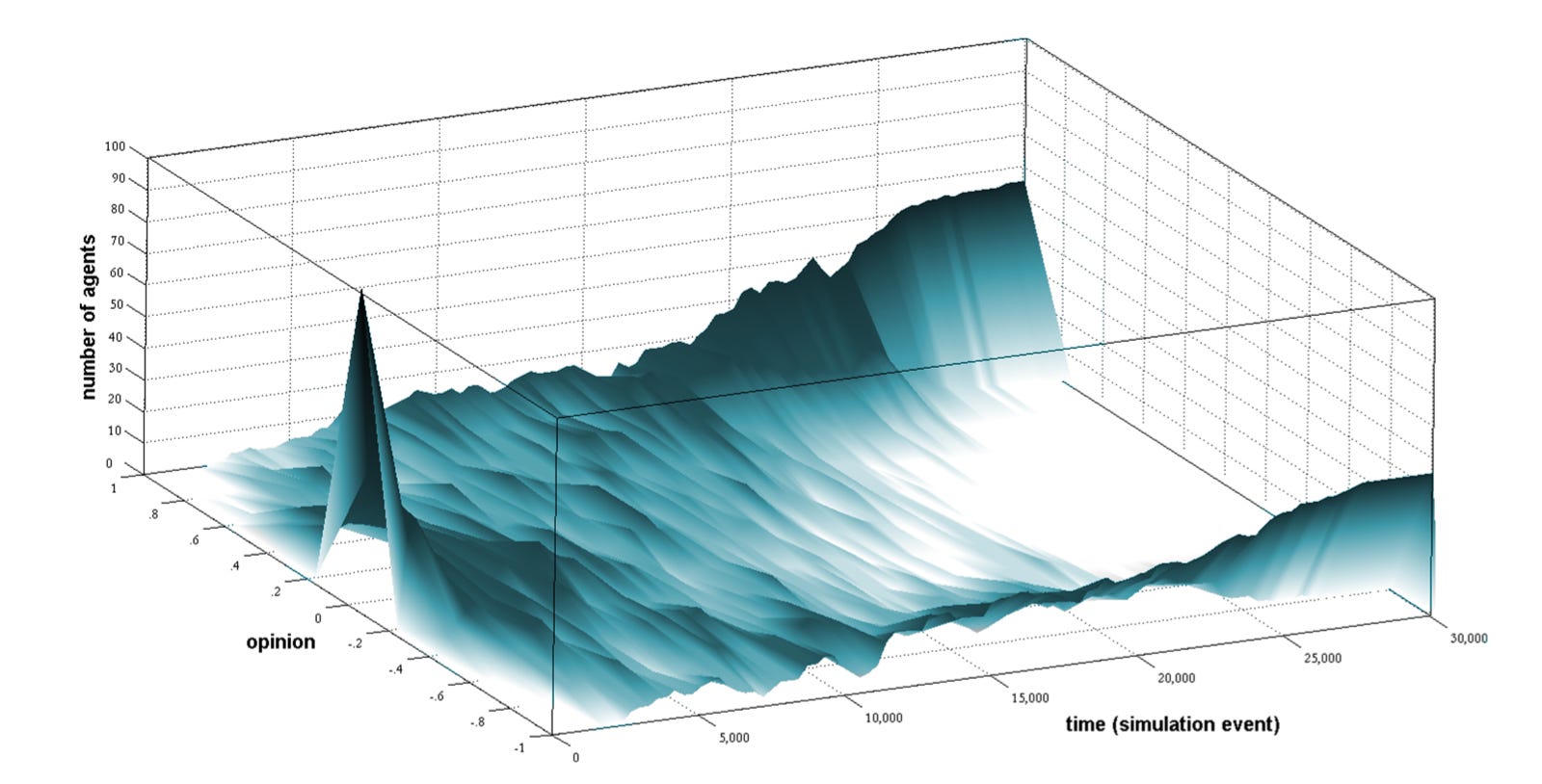
Again, the result is near-complete polarity, with no centrists whatsoever as the simulation matures. Note that every agent started dead center, with an equal split of pro and con arguments in their little agent heads. Mäs and Flache describe the mechanism:
[I]nteraction partners with similar opinions can provide each other with new arguments which reinforce their initial opinion and, thus, leads to intensified views that may be more extreme than those of any of the participants were prior to the interaction.20
So, once more, get opinions swirling and nudge the agents to agree or conform via some type of social influence, and the result is polarization or even extremism.
Mäs and Flache designed the simulation alongside a human version, run with real, fleshy subjects in their lab. First, the subjects were given pro and con arguments to seed their opinions. The topic was deliberately low-stakes: where to build a leisure center in a fictitious town. They were then paired homophilically and instructed to share sympathetic arguments. As predicted, this produced substantial polarization.
But there was a second phase to the human study, the real punchline to the whole project. After the homophilic (and polarizing) segment, subjects were paired with those who disagreed – heterophilic pairings in the parlance of this study. In these interactions subjects naturally shared arguments that were contradictory or conflicting. Rather than create more ideological distance, these pairings led to a convergence of belief.
In both the sim and human variants of the Mäs and Flache research, the conclusion was that the observed polarization wasn’t driven by disagreement between sides. It was driven by agreement within each side.
So it seems that polarization and conformity (or at least social influence cut from the same cloth) are extremely similar mechanisms, just at different scales. The tendency to conform with our local group strengthens cohesiveness, making it comfortable to dig in our collective heels, right or wrong. But then scale things up to the group level. Now when that local in-group encounters an out-group (who has been similarly digging their heels into different soil), some degree of ideological distancing is inevitable. Iterate and try again: more heel-digging, more ideological distance, more polarization. And so it goes, until it’s difficult to imagine either side being more at odds with one another. Sound familiar?
Frictionless, Profitable Bullshit
If social influence is a necessary ingredient for all of this, it makes sense to look at the most efficient conformity machine ever built: social media.21 In some sense, we should be living in an age of unprecedented consensus. All the information we need to form rational, evidence-based opinions is a click away. All we need to add is a shared objective reality and agreement on basic facts.
But we don’t do that! If Asch showed us anything, it’s that we absolutely can disagree on unambiguous facts, and we will deny reality if the social cost is too high.
To make matters worse, we show up to the social media party already vulnerable to its influence – primed to conform to the expectations of our peers, dismiss any evidence that doesn’t fit our narrative, and confirm what we already believe without scrutiny.
This makes us easy for social media algorithms to exploit: feed us evidence that aligns with what we (and our tribe) already think, and we’ll respond with a thumbs-up or a repost to signal our conformity publicly. The business result is habitually returning customers, the holy grail of any capitalist enterprise. The mental health result is some users engaged so ravenously that it looks an awful lot like clinical addiction (even if psychologists are still arguing about the label). And the societal result is two warring factions, looking at the same verifiable facts and coming to opposite conclusions.
But don’t mistake this for both-sides-ism. Notice none of the research above implies that both camps are “halfway wrong.” One side could be totally wrong and the other totally right, and these models would paint the same picture of polarization. Which brings us back to MAGA…
This is the usual place in an essay on polarization where we start to hum kumbaya, reach across the aisle, learn to listen to each other once again, maybe even kiss a little. The gesture gets raised in good faith by reasonable people, and it’s the default position in most polite company. How could we hold someone morally accountable for these invisible network dynamics? Doesn’t this let MAGAs off the hook for their shitty behavior?
No, it does not.
“It’s just human nature” is an excuse creeps reach for when they get caught being naughty and want to slither away from the consequences. But, to be pithy and alliterative, explanation is not exoneration. We don’t treat “human nature” as a get-out-of-jail-free card anywhere else. We can use science to explain what’s driving racism, war, rape, genocide, and torture, but science doesn’t grant passes on those things either.
For the record, I don’t claim to be immune to conformity. And I love my soothing little echo chamber. There’s some satisfaction to be had about being on the right side of history. Of course I’m subject to all the biases I’ve just written about. So is every researcher in this piece. So is my mom, and so were Mother Teresa and Mr. Rogers. Plenty of people are targets of propaganda but don’t salivate over cruelty, pettiness, scapegoating, or kleptocracy. So, no, nothing about this excuses Trumpism.
Brittle Hive Minds
In the Asch experiments, recall that subjects went along with the group rather than the evidence on roughly a third of trials. And when the experiment was replicated in 2023, but reframed as political opinion instead of line lengths, the conformity rate jumped to 38%.22 These findings shed a little daylight on how we got here – how anyone can believe the obvious bullshit peddled by MAGA.
But Asch also ran a variant that might give us a clue as to what we can do about all of this. He added a single confederate instructed to give the correct answer out loud, thus breaking the unanimity of the group. The experimental subject always responded after this dissenter, so they knew they wouldn’t be the lone holdout. The presence of this dissenting voice dropped the group’s error rate from an unsettling 32% to a tolerable 5.5% – bullshit levels undoubtedly easier to manage. Asch put it this way:
It is clear that the presence in the field of one other individual who responded correctly was sufficient to deplete the power of the majority, and in some cases to destroy it.23
The Anatomy of a Bamboozle (and an Emperor)

Hans Christian Andersen wrote The Emperor’s New Clothes in 1837 Copenhagen, a subject of King Frederik VI, who was a dick. Under his rule Denmark went bankrupt, surrendered Norway to Sweden after a 400-year run, and lost its entire naval fleet to the British.24
Frederik also presided over a fierce censorship regime backed by the 1683 Danish Code governing speech crimes. King-insulters would have their right hand cut off while alive, then be graciously put out of their misery via quartering and beheading. Blasphemers were spared their hand but at the expense of their tongue. The law mandated that these leftover heads, tongues, and hands be publicly displayed on sticks, sure to befuddle any passerby who hadn’t heard the backstory.25
Understandably, Andersen had no particular appetite for pissing off Frederik, but he did have some real social commentary to get off his chest. So, he disguised his royal critique as a kids’ story, a fairy tale with a nameless emperor of a nameless land. In it, grifting weavers had convinced the emperor his new clothes would be invisible to anyone who was a simpleton or unfit for office.
Andersen had adapted the story from a 1335 Spanish source, Juan Manuel’s El Conde Lucanor. In that version the clothes were invisible to anyone of illegitimate birth, a sneaky way to suss out adulterers. But Andersen was more concerned with cowardly mass complacency. So, he added the lone dissenting voice of a child, which broke the façade wide open. It had to be a child, too naïve to know it’s rude to point and laugh when you see a guy in a funny hat parading down the street with his nuts hanging out.
A little more than a century later, Asch backed up Andersen’s intuition with data, giving the story some actual diagnostic credibility. The mechanism is worth noting: a small but loud minority can have an outsized effect on conformity. But understanding the mechanism and breaking the spell are two different things. Carl Sagan, always uncannily prescient, laid out the challenge about a year before his death:
If we’ve been bamboozled long enough, we tend to reject any evidence of the bamboozle. We’re no longer interested in finding out the truth. The bamboozle has captured us. It’s simply too painful to acknowledge, even to ourselves, that we’ve been taken. Once you give a charlatan power over you, you almost never get it back.
— Carl Sagan (The Demon-Haunted World)
The word to dwell on is “almost.” Sagan was a scientist who chose his words with precision. He knew that the odds of escaping cultism are depressingly slim. And he knew that the fear of embarrassment for being a sucker is a nearly impossible nut to crack. But not totally impossible.
Perhaps we should apply folk wisdom that’s gone unheeded for centuries and codified by science for decades. You don’t need to convert that smug coworker or obnoxious neighbor regurgitating Fox News talking points to a reflexively nodding audience. They’re too deep in the Kool-Aid. But remaining quiet, politely staying in your lane, just reinforces the presumption of unanimity. You need to break the silence for the crowd.
The good news is that you need only state the obvious, because reality is on your side. There might be an exhausted member in the crowd who needs a signal that reality is still available to them. Your dissent will dramatically bring down the social cost of defection for them. And it might give them permission to finally leave the cult.
Cailin O’Connor is a Chancellor’s Professor in the Department of Logic and Philosophy of Science at University of California, Irvine. She is a philosopher of social and behavioral science, philosopher of science, and evolutionary game theorist. Her books include The Misinformation Age: How False Beliefs Spread, The Origins of Unfairness: Social Categories and Cultural Evolution, Games in the Philosophy of Biology, and Modelling Scientific Communities.
Video recorded April 8, 2025. Produced and edited by Jonathan Fowler. Editorial framing and political interpretation are the author’s alone, and do not necessarily reflect Professor O’Connor’s views.
The original 1951 article by Asch has well over 8,000 citations on Google Scholar.
Solomon E. Asch, “Effects of Group Pressure Upon the Modification and Distortion of Judgments,” in Documents of Gestalt Psychology, ed. Mary Henle (Berkeley, CA: University of California Press, 1961), 222–236. Originally published in Groups, Leadership, and Men, ed. Harold Guetzkow (Pittsburgh, PA: Carnegie Press, 1951).
Franzen and Mader (2023) also found that financially incentivizing accuracy only dropped the visual error rate to 25 percent. Even when literally paid to tell the truth, a quarter of responses still deferred to the crowd. When the task was framed politically the error rate jumped to 38%.
Axel Franzen and Sebastian Mader, “The Power of Social Influence: A Replication and Extension of the Asch Experiment,” PLOS ONE 18, no. 11 (2023): e0294325.
Rod Bond and Peter B. Smith, “Culture and Conformity: A Meta-Analysis of Studies Using Asch’s (1952b, 1956) Line Judgment Task,” Psychological Bulletin 119, no. 1 (1996): 111-137
Cailin O’Connor and James Owen Weatherall, The Misinformation Age: How False Beliefs Spread. Yale University Press, 2019.
Hanti Lin, "Bayesian Epistemology," The Stanford Encyclopedia of Philosophy (Fall 2022 Edition), edited by Edward N. Zalta and Uri Nodelman.
In the video O'Connor mentions the "wisdom of the crowds" and its occasional surprising accuracy. It's great for Who Wants to Be a Millionaire? or crowdsourcing Bessie's weight at the state fair, but one of the non-negotiable conditions for this phenomenon to occur is independence of opinion. That is, there can be no deliberation among individuals, no sharing of hunches, no knowledge of others' votes. As soon as that rule is broken, all bets are off.
See James Surowiecki, The Wisdom of Crowds: Why the Many Are Smarter Than the Few and How Collective Wisdom Shapes Business, Economies, Societies and Nations. Little, Brown, 2004.
O’Connor & Weatherall (2019), pg. 59.
O’Connor & Weatherall (2019), pg. 61.
O’Connor & Weatherall (2019), pgs. 71-72.
O’Connor & Weatherall (2019), pgs. 72 & 200.
O’Connor & Weatherall (2019), pg. 73.
Charles Lord, Lee Ross, and Mark Lepper, “Biased Assimilation and Attitude Polarization: The Effects of Prior Theories on Subsequently Considered Evidence,” Journal of Personality and Social Psychology 37, no. 11 (1979): 2098–2109.
O’Connor and Weatherall use a modeling framework adapted from economists Venkatesh Bala and Sanjeev Goyal. See Venkatesh Bala and Sanjeev Goyal, "Learning from Neighbours," Review of Economic Studies 65, no. 3 (1998): 595–621.
For more studies with different approaches yet similar findings see:
Erik J. Olsson, "A Bayesian Simulation Model of Group Deliberation and Polarization," in Bayesian Argumentation, ed. Frank Zenker (Dordrecht: Springer, 2013), 113–133.
To the extent that Bayesian reasoning is normatively correct, the bottom line is that polarization and divergence are not necessarily the result of mere irrational “group think” but that even ideally rational inquirers will predictably polarize or diverge under realistic conditions.
Folco Panizza, Alexander Vostroknutov, and Giorgio Coricelli, "How Conformity Can Lead to Polarised Social Behaviour," PLOS Computational Biology 17, no. 10 (2021): e1009530.
Our analyses indicate that participants polarise their social attitude mainly due to normative expectations. Specifically, most participants conform to presumed demands by the authority (vertical influence), or because they learn that the observed human agents follow the norm very closely (horizontal influence).
Pranav Dandekar, Ashish Goel, and David T. Lee, "Biased Assimilation, Homophily, and the Dynamics of Polarization," Proceedings of the National Academy of Sciences 110, no. 15 (2013): 5791–5796.
Michael Mäs and Andreas Flache, "Differentiation Without Distancing: Explaining Bi-Polarization of Opinions Without Negative Influence," PLOS ONE 8, no. 11 (2013): e74516.
Encyclopedia Editorial Office, "Homophily," Encyclopedia (MDPI), February 8, 2024.
See also Miller McPherson, Lynn Smith-Lovin, and James M. Cook, “Birds of a Feather: Homophily in Social Networks,” Annual Review of Sociology 27 (2001): 415-444.
Mäs & Flache (2013), pg. 2.
Mäs & Flache (2013), pg. 5.
The Zollman Effect: Named after Carnegie Mellon philosopher Kevin Zollman, it says that a community can become worse at finding the truth if there is too much information sharing. The idea is that those aforementioned bad strings of evidence sometimes break onto the scene with too much oomph, sending agents on their way to coalesce around the incorrect answer.
The counterintuitive fix is to slow information flow down, keeping some agents (mostly) siloed, so novel good ideas can take hold and gain some evidentiary strength before they make it to the wider network. Through the Zollman lens it’s not surprising that social media (a system designed for frictionless information sharing at maximum speed) is a breeding ground for bullshit.
Kevin J. S. Zollman, "The Communication Structure of Epistemic Communities," Philosophy of Science 74, no. 5 (2007): 574–587.
Franzen and Mader (2023), pg. 1.
Asch (1951/1961), pg. 231.
“Frederick VI of Denmark," Wikipedia.
Frederik’s Denmark also continued to preside over plantation slavery in the Danish West Indies. On St. Croix in 1803, the island’s population was 30,000; 26,500 were enslaved people who planted, harvested, and processed cane on 218 plantations.
National Park Service, “Saint Croix’s Golden Age of Sugar,” Christiansted National Historic Site, U.S. Department of the Interior.
Kong Christian den Femtes Danske Lov [King Christian V's Danish Code], 15 April 1683, articles 6-1-7 and 6-4-1. See retsinformation.dk.
See also Armin Langer, "Quran burning in Sweden prompts debate on the fine line between freedom of expression and incitement of hatred," The Conversation, August 29, 2023.
The 1683 code was slightly defanged by the Orwellian Press Freedom Regulation of 1799, which called for banishment of three years to life for offending royalty. Death remained on the books for the most serious press offenses.
— Orwell pull quote: George Orwell, “The Freedom of the Press“ (proposed Preface to Animal Farm, written 1945), first published in The Times Literary Supplement, September 15, 1972.
— Sagan pull quote: Carl Sagan and Ann Druyan, The Demon-Haunted World: Science as a Candle in the Dark (New York: Ballantine Books, 1997), 241. (First released 1995. Sagan died December 20, 1996.)

